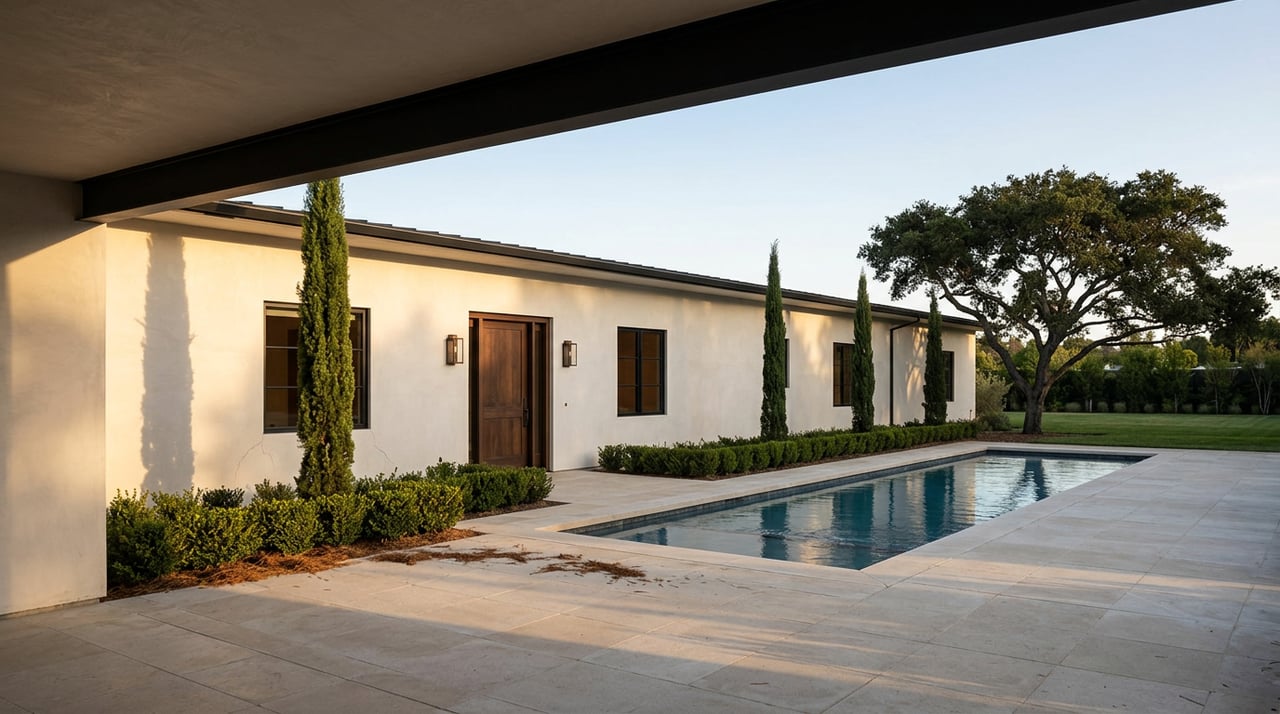
A buyer touring a Covenant estate last spring found a laminated card taped inside the pool equipment enclosure: County of San Diego, permit finaled, inspection passed. The agent pointed to it as proof the pool, the raised patio, and the low retaining wall around it were all above board. What the card didn't show was whether the Rancho Santa Fe Association's Art Jury had ever seen the plans at all.
The gap between a county sign-off and an Association sign-off matters when checking approvals. It's not a technicality. It's the direct result of how the Covenant is built: two separate reviewing bodies, two separate sets of records, and no single document that proves both said yes.
Two Approvals, One Address
Rancho Santa Fe sits in unincorporated San Diego County, so every building permit for grading, structural work, plumbing, or electrical runs through the county's Planning & Development Services department, the same office that handles permits for any unincorporated parcel in the county. That's one track.
The second track belongs to the Rancho Santa Fe Association. Properties inside the historic Covenant, roughly ten square miles with an average parcel over two acres, are bound by the Protective Covenant, a recorded agreement among property owners that predates most of the homes standing today. Enforcement runs through the Association's Art Jury, sometimes called the Covenant Design Review Committee, which reviews exterior work for what the Covenant calls a "high artistic result."
Neither track substitutes for the other. County permits don't confirm Covenant compliance, and Art Jury sign-off doesn't clear a project with the county. A homeowner, or a buyer inheriting someone else's project, needs both stamps on the same work before it's actually settled.
| RSFA Art Jury / CDRC | San Diego County PDS | |
|---|---|---|
| What it reviews | Exterior design, materials, colors, siting, view corridors | Structural, electrical, plumbing, grading, life safety |
| Filed with | Rancho Santa Fe Association Building Department | County Planning & Development Services |
| Typical process | Concept submittal, then final submittal with drawings and material board | Plan check, permit issuance, phased inspections |
| What it doesn't replace | County permits, fire district review | Association architectural approval |
How Long Review Can Take
Covenant review isn't a single meeting. A concept submittal comes first, a final submittal with complete drawings and a material board comes second, and conditions of approval between the two rounds are the norm rather than the exception. Projects queue first-come, first-served, which means a homeowner who assumes a six-week turnaround can find themselves waiting months behind other applications filed the same season.
Approvals also expire.
One San Diego landscape design-build firm that works regularly inside the Covenant put the consequence of skipping the process plainly: work started without CDRC sign-off is work that gets stopped. That's not a caution reserved for additions and second stories. It applies to a retaining wall, a redesigned motor court, or a mature tree removed to open a view.
Not Every Rancho Santa Fe Address Answers to the Same Body
The Art Jury governs the original Covenant, but several sought-after communities that share the Rancho Santa Fe name and zip code sit outside it entirely. Fairbanks Ranch, The Bridges, Cielo, Santaluz, and The Crosby each operate under their own homeowners association with a separate architectural review process, distinct from the Covenant's and often faster or slower depending on the community's own rules.
That distinction matters before an offer goes in, not after. A buyer comparing a Covenant lot to a Santaluz lot isn't just comparing lot size and finish level. They're comparing which reviewing body will approve the pool house they're already sketching, and how long that body typically takes.
Recent Changes to Association Review
Recent developments show why it matters to distinguish the Association's projects from homeowners' work.
In January, the Association's Board took up two resolutions that changed how design review works for the Association's own common-area projects, creating a process distinct from the one individual homeowners follow under the Protective Covenant. Coverage in the Rancho Santa Fe Post described the shift as one that moves more authority to Building Department staff and separates how the Association's own projects are reviewed from how a homeowner's remodel is reviewed. These resolutions concern the Association's own projects, not individual homeowners' review process. Buyers planning future work should confirm the requirements in effect at that time.
The Association's Building Department also moved its application system onto Accela, new permitting software that launched in 2026 and is meant to let members submit digitally and track project status online, according to the RSFA's own architectural review page. For due diligence, that's a real improvement. A buyer's agent or attorney can now request a project's status history rather than relying on paper files that may or may not have survived a prior owner's file cabinet.
The clearest illustration of how much weight Art Jury approval carries, and how much it doesn't, is playing out right now over a proposed 168-unit senior living and memory-care community called Silvergate Rancho Santa Fe. The project, put forward by Solana Beach-based AmeriCare Health & Retirement on roughly 23 acres near Via de la Valle and Calzada del Bosque, would be the first development of its kind inside the historic Covenant. Reporting from SanDiegoVille lays out the core tension: Art Jury approval is not county approval, and San Diego County's Major Use Permit process still gives the county an independent look at land use, traffic, and environmental impact before anything gets built. The Association's own Board adopted a resolution in February 2025 determining the use was consistent with the site's zoning designation, a position the Association's Building Commissioner has defended publicly, but opponents argue the project runs against covenant language nearly a century old and would require a formal member vote to change. As of this writing the fight is unresolved.
None of that changes a homeowner's kitchen remodel. But it's a useful reminder that Association approval and county approval are separate questions, even for a project with far more institutional weight than a backyard pool.
What to Request Before You Write an Offer
The practical fix is simple to describe and easy to skip under time pressure. Before writing an offer on a Covenant property with visible improvements, ask for:
- All prior RSFA Art Jury or CDRC approvals, concept and final, for any exterior work
- All corresponding County PDS permits and final inspection records for the same work
- As-built plans, if the seller has them, for pools, walls, barns, or additions
- Confirmation of whether the parcel is on septic or connected to public sewer, since septic capacity can constrain future additions
- Trail easement documentation if the lot borders or crosses a bridle path
A seller who can produce a full matched set for both tracks has effectively de-risked the property. A seller who can only produce the county side, or only the Association side, has left a question that will need answering eventually, and escrow is a far better time to answer it than the year after closing.
Frequently Asked Questions
Does a kitchen remodel need Art Jury approval if it doesn't touch the exterior? Generally no. Interior-only changes that don't affect the roofline, exterior elevation, or windows and doors typically stay outside Covenant review, though the county may still require permits for plumbing or electrical work.
If my neighbor's project was approved, does that mean mine will be too? Not necessarily. Approvals are project-specific and site-specific, and conditions attached to one property's approval, such as view corridor concerns, may not apply the same way next door.
If you're evaluating a Covenant property and want a clear read on its approval history before you write an offer, Tiffany Williams can help you pull the right records and ask the right questions early.
This article is general information, not legal, tax or financial advice. Consult a qualified professional about your situation.