Ever wonder if that “price per square foot” number on a San Diego listing really tells you if it’s a good buy? You’re not alone. PPSF is a handy shortcut, but it can mislead you if you don’t know what it includes and what it misses. In this guide, you’ll learn how to read PPSF the right way in San Diego, when to lean on it, and when to ignore it. Let’s dive in.
What price per square foot means
Price per square foot (PPSF) is simply the sale price divided by the home’s finished living area. It helps you compare homes on a common scale. Think of it as a quick check, not a full valuation.
“Square footage” usually refers to interior finished living area. Garages, balconies, patios, unfinished basements, and detached structures typically do not count. MLS and assessor measurements can differ, and while the ANSI Z765 standard is common for single-family homes, local practices vary.
There are different PPSF flavors. Sale PPSF uses closed sales and is the most reliable for market value. Listing PPSF uses asking prices, which can diverge when the market shifts. Many pros prefer the median PPSF because it softens the impact of outliers.
Why PPSF varies across San Diego
San Diego is a patchwork of micro-markets. A few blocks can change demand and PPSF.
- Coastal micro-markets like La Jolla, Pacific Beach, Ocean Beach, and Mission Beach often command higher PPSF than inland areas. Proximity to job hubs like downtown, UC San Diego, Sorrento Valley, and military bases also shapes demand.
- Property type matters. Condos and townhomes behave differently than single-family homes because of HOA dues, shared amenities, and unit sizes. Small luxury condos can show very high PPSF.
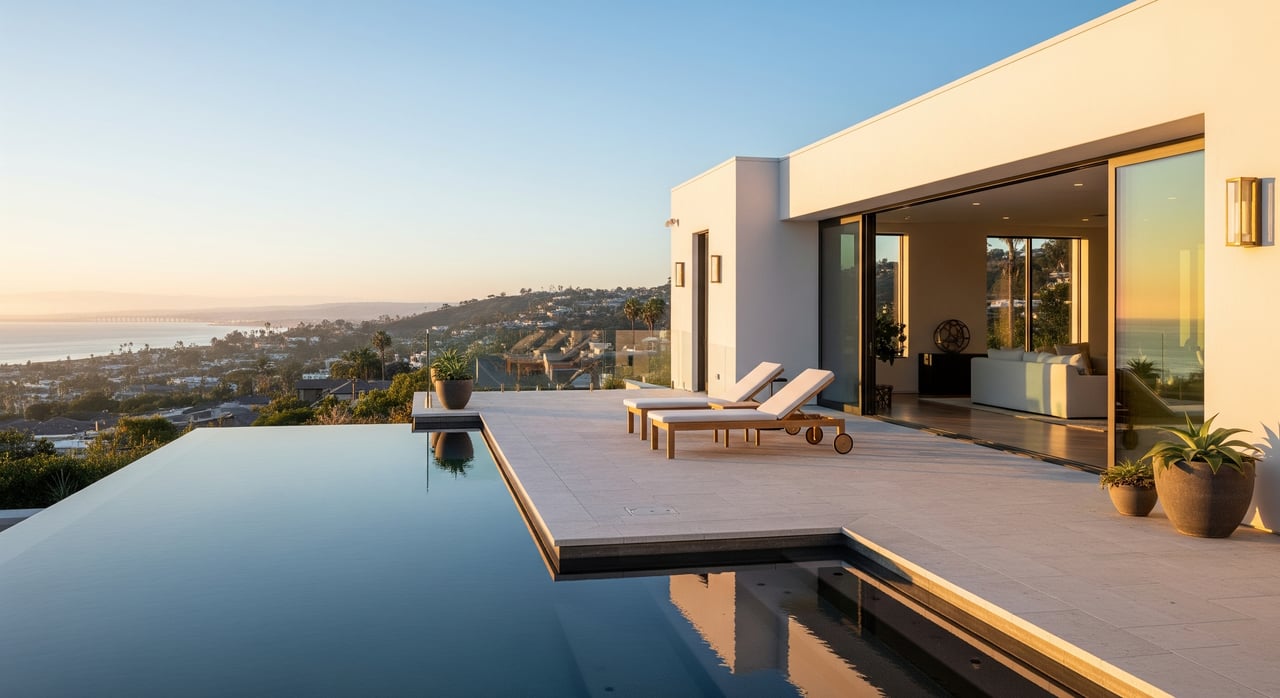
- Views and orientation are big factors. Ocean, bay, canyon, and city views create premiums that a simple PPSF number does not capture.
- Age and renovation level shift PPSF. Historic or period homes can trade differently depending on permitted updates and finish quality.
- Smaller homes often sell at a higher PPSF than larger ones. This “small-home premium” makes PPSF non-linear.
- Lot size and usability can add more value than interior area in some neighborhoods, which means PPSF may undervalue big lots.
- Taxes, Mello-Roos or special districts, and local fees can affect willingness to pay. Market cycles, interest rates, and inventory also move PPSF up or down.
- Local nuisances like airport flight paths, freeway noise, and coastal erosion risk are not reflected in PPSF.
How to calculate PPSF correctly
The formula is straightforward: PPSF = sale price ÷ finished living area. Use finished, permitted living area for the most consistent results.
Example (illustrative): A home sells for $1,200,000 and shows 1,500 sq ft of finished living area in the MLS. PPSF = $1,200,000 ÷ 1,500 = $800 per sq ft.
For accurate comparisons, rely on closed sales. Compute the median PPSF for your set of comps to reduce the impact of unusual sales.
Use PPSF the right way
Follow a simple workflow to keep PPSF useful and honest:
- Define the peer set. Compare the same property type, similar bed/bath counts, and similar lot features in the same micro-market. In urban San Diego, that often means within 0.5 to 1 mile.
- Use recent closed sales. Aim for the last 3 to 6 months in active neighborhoods. Stretch the timeframe only when turnover is low.
- Focus on median PPSF, not average, to reduce outliers.
- Adjust for meaningful differences. Consider size, views, condition, lot, parking, and permits.
- Validate with other checks. Look at sale-to-list ratio, days on market, and any available appraisal references.
Smart adjustments that matter
- Size: Expect smaller homes to show higher PPSF. Do not scale price linearly from a 900 sq ft condo to a 2,200 sq ft home.
- Views: Ocean, bay, canyon, or skyline views justify premiums that PPSF alone will miss. Use comps with similar views when possible.
- Condition: Updated kitchens, baths, and systems can push PPSF higher than original-condition homes nearby.
- Lot, garage, and parking: Where land is scarce, lot size and usable outdoor areas hold real value. Account for them separately.
- Condos: Factor HOA dues and any special assessments into the effective monthly cost. A unit with lower PPSF but high dues may not be the better buy.
- Permits: Confirm that added space is permitted. Unpermitted area often gets excluded by appraisers, which distorts PPSF.
Common pitfalls to avoid
- Mixing measurements. MLS, assessor, and appraiser square footage can differ. Pick one source and be consistent.
- Counting unpermitted space. If you include it in the denominator, you can understate PPSF and misread value.
- Small sample sizes. In thin markets, a few sales can swing PPSF. Broaden the time window if needed and use median.
- Cross-type comparisons. Do not compare a condo’s PPSF to a single-family home’s PPSF as if they behave the same.
- Assuming linear pricing. PPSF is not constant across sizes. Smaller places usually carry higher PPSF.
Where to find accurate San Diego PPSF
- San Diego Association of Realtors and the local MLS offer the best closed-sale detail and neighborhood CMAs.
- The San Diego County Assessor provides parcel-level building area and lot size, plus tax and assessment history.
- The County Recorder shows official sale records and deed history to verify sale prices and dates.
- City of San Diego Development Services and permit portals help you confirm whether added space is permitted.
- SANDAG and the California Association of Realtors offer regional and statewide context on market drivers.
- National tools with PPSF heatmaps are useful for trends, but always cross-check with recent closed sales from the MLS.
Quick examples (illustrative only)
- Coastal view vs inland size: A 1,100 sq ft cottage near the coast with a partial ocean view can show a higher PPSF than a 2,200 sq ft inland home, even if the inland home has a larger yard. View and land scarcity drive the difference.
- Condo PPSF vs total cost: A condo with a slightly lower PPSF but high HOA dues may cost more per month than a comparable unit with a higher PPSF and modest dues. Compare PPSF and total carrying costs side by side.
When to lean on a local pro
Use PPSF as your first pass, then fold in local comps, permit history, and total monthly costs to make a confident decision. If you want a clean, current read on your micro-market, a streamlined CMA, and financing options aligned with your offer strategy, our boutique team pairs expert representation with in-house lending coordination to help you move faster and smarter.
Ready to price or purchase with clarity? Connect with Tiffany Williams for a neighborhood-specific PPSF review, a tailored CMA, and integrated mortgage guidance.
FAQs
What is price per square foot in San Diego real estate?
- It is the sale price divided by finished living area, a quick comparison tool that excludes spaces like garages and typically uses MLS or assessor measurements.
Why do coastal and inland San Diego PPSF numbers differ so much?
- Coastal homes carry location and scarcity premiums, including views and beach access, which raise land value and PPSF versus inland areas.
Can you compare condo PPSF to single-family PPSF?
- Compare within the same property type first, since condos have HOA dues and shared amenities that change total cost and resale dynamics.
How do permits and unpermitted rooms affect PPSF?
- Appraisers and assessors rely on permitted living area; unpermitted additions may be excluded, which can distort PPSF if they were counted in a listing.
How often should you refresh PPSF comps in San Diego?
- In active neighborhoods, meaningful shifts can happen within months, so use closed sales from the last 3 to 6 months when possible.
How should a seller use PPSF to set price?
- Start with local median PPSF, then adjust for view, lot, renovations, and permitted space, and verify with a full CMA of recent closed comps.
How should a buyer use PPSF when evaluating an offer?
- Use PPSF to spot outliers versus recent sales, then weigh condition, planned renovations, and total monthly costs like taxes, insurance, and HOA dues.
Where can you find reliable PPSF data for San Diego homes?
- The local MLS, the San Diego County Assessor, the County Recorder, and city permit portals provide the most dependable data for comps and verification.